
Why Don't You Want More From Us Than This
Nothing is inevitable, no matter what they tell you.


Last semester, at the community college where I teach, I participated in a “Community of Practice” regarding AI in higher education. Basically we were given a syllabus of readings, videos, and podcasts from people on every side of the issue, and got together once a month to discuss our reactions and how those readings might influence our own approaches in the classroom.
My own disgust with AI is well-trod territory in this newsletter and I won’t rehash it all again here. But despite being one of the only hardliners in the group, which by comparison has a tendency to make me feel like a zealot, I was heartened by what I found in one of the readings we completed for our final session:
The fact is that many students, even regular users, are deeply ambivalent about AI. The Gallup-Walton Family Foundation survey, called “Voices of Gen Z: the AI Paradox,” points this out. I’ve said this before, but I think it bears repeating: Young people aren’t that different from their teachers and professors in this regard.
“Over the past year, Gen Zers’ sentiment toward AI has grown significantly more negative on three of the four emotions measured in both years,” the report states. “Excitement for AI has dropped 14 percentage points since 2025 and hopefulness has fallen nine points, while anger has increased nine points. At the same time, anxiety about AI is steady.”
Fewer Gen Zers in 2026 than in the previous year said that AI will meaningfully improve their search for information or generate new ideas. A majority in the 2026 survey also said that AI designed to complete tasks will make learning more difficult.
Jay Caspian Kang, in a recent New Yorker piece, also provides some anecdotal evidence along these same lines:
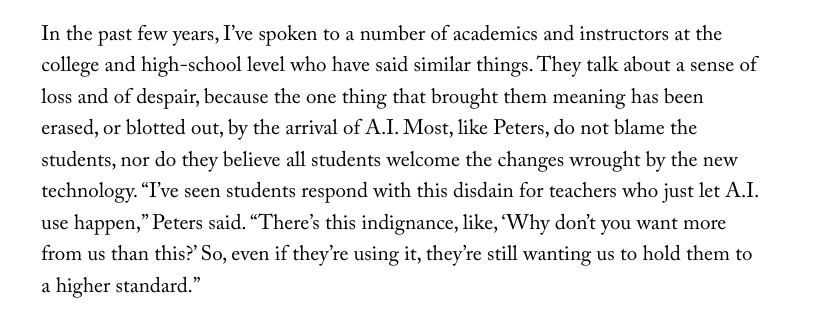
Put simply, despite the rampant use of AI tools that both circumvent and erode learning in higher ed, the students themselves are deeply ambivalent about the value of such tools, even if they use them all the time.
In other words, the “inevitability” of AI is nothing of the sort. Generously, a failure of imagination and integrity on the part of university adminstrators has led us here. Less generously, this crisis is clearly the byproduct of the neoliberal destruction of public goods—it’s been obvious to many of us who teach at the college level for some time now that most university administrators are functionally managers of real estate and investment portfolios that happen to offer some classes as customer experiences, rather than governors of hallowed sites of learning.
We are here, in other words, because of inertia rather than enthusiasm, and this inertia is downstream of institutional capture.
While this state of affairs is profoundly depressing, I think it also offers a glimmer of hope with regard to resistance. It is entirely possible for individual professors, lecturers, adjuncts, and TAs to lead from the front on this issue. To demand, as Kang’s interviewee does, more from our students. Individual resistance is no substitute for structural change, but in this case there seems to be a clear enough pathway from one to the other that it’s worth fighting the tide.
All it requires—besides a willingess to be the square peg at one’s respective department meetings—is an understanding that this “inevitability” is entirely manufactured, and manufactured with the express purpose of serving the ruling class. You don’t have to wear a tinfoil hat to ask and answer the following questions: Who benefits from the mass intellectual deskilling of the American people? Who benefits from the destruction of basic shared truths in favor of hyperindividualized, algorithmically reinforced personal “realities”? What does a world look like in which no one knows how to do anything for themselves, but believes they know everything? (And, less philosophically: What happens to all of these learners who don’t know how to do things without AI when the companies behind those products jack up subscription prices for their fully-captured users?)
To be honest I’ve moved beyond anger, mostly, into complete boredom with all of this stuff. It’s exhausting at the cellular level to have these same conversations week in and week out with people who capitulated right up front and are now trying to piece together educational programs, or society itself, from materials that fundamentally don’t work.

Instead I’ll offer this: for the past few months I’ve been co-coaching a middle school flag football team. I don’t spend much time around kids otherwise and it’s been illuminating to be in charge of a few dozen fifth- and sixth-graders on these spring afternoons. One of the most illuminating things has been the distance between how tough they act and how easily they break down; pretty much every practice and game has seen at least one kid storm off the field, often in tears, because something went wrong.
But this, too, is an opportunity to lead from the front. One I’ve tried to learn from my coaching partner Matt is that these kids deserve just as much honesty, transparency, and maturity from us as we expect of them. And there is no shortage of opportunities to work on those things: at every single practice, I can point to at least two or three moments when I have failed to show a twelve-year-old some grace. At thirty-five that’s pretty embarrassing, honestly, and the only way to carry it is to apologize for those failures and take accountability in front of all the kids. I should have explained this drill a second time instead of making everyone run a lap because a few people weren’t listening the first time. I should have remembered to sub in K during the second half of the scrimmage, that’s on me. I forgot that I promised D he didn’t have to play center today, and I want to thank him for stepping up anyway. And so on and so on.
Getting here, to this point of leading from the front—or to the point of being polished enough to avoid making these mistakes in the first place, the ones I make over and over again—starts, I think, with paying attention. Attention to what you’re doing, to the faces in front of you, to the relationship between those two things. You pay attention long enough and you can develop frameworks so that you’re not constantly lashing out in reaction to things, or giving in to the inertia of the moment so completely that you miss the whole point of doing what you’re doing.
Attention. That’s a big one. We owe each other our attention, curiosity, and grace. I refuse to believe otherwise. It’s hard to believe this because it’s hard to live this way, or at least it is for me; you have to get very used to the idea that you’re going to fuck up all the time and fall short. As a teacher, coach, and spouse, to name a few. But what’s the alternative? The “inevitable” degradation of everything that makes us human, I’d guess.
You can apologize to children. You can demand more of your students, friends, colleagues, bosses. You can build up your own defenses against the poisons of our age. It’s hard and it sucks but it’s profoundly necessary if we’re ever going to get anything better.
Thanks, as always, for reading. I’ll talk to you next time.
-Chuck
PS - If you liked what you read here, why not subscribe and get this newsletter delivered to your inbox each week? It’s free and always will be, although there is a voluntary paid subscription option if you’d like to support Tabs Open that way.
PPS - I have a new poem out over at Some Words. Baseball, baking, the failures that make us who we are—it’s got a little bit of everything.
It's heartwarming seeing someone older than me realize how much little kids actually teach us. I work with special needs' children and adolescents and am routinely surprised at how much of a mirror they hold up to us and force us to reconcile our own shortcomings as human beings - despite having been been adults for, well, a long time. My favourite bit was the part about leading our relationships by holding and giving our attention, curiosity and grace. I try to live my life by those values too, as opposed to becoming embittered and hopeless. I think it requires more bravery than most folk anticipate; I certainly didn't until I became an adult.
Thanks for the illuminating and candidly written piece, Chuck