
And, And I Don't Know
It's hard work, learning to experience things without the goggles of habit.


In the 2006 film The Departed, there’s a line Matt Damon’s crooked cop says to his girlfriend, a therapist played by Vera Farmiga, that’s been echoing around my brain lately.
If we’re not gonna make it, it’s gotta be you that gets out, ‘cause I’m not capable. I’m fuckin’ Irish, I’ll deal with something being wrong my whole life.
That last bit, I mean. I’ve always prided myself on my coping skills, on sticking it out, on being able to deal with something being wrong indefinitely—maybe even for my whole life.
There are some obvious drawbacks to this way of living. I say obvious; they’ve only recently become so for me. Not least of which is the realization that if your only coping mechanism is, well, coping, you haven’t given yourself a lot to fall back on when you inevitably find yourself unable to cope.
And this realization has led to some hard questions. Namely: am I really resilient, am I really coping—do I really not care enough to be affected by less-than-ideal situations—or am I trying to avoid the hard work, the responsibility, of caring?
If I’m honest with myself, it’s more often the latter than I’d care to admit. Some of it always has been. It takes work to care about what happens to you, and because it’s work, sometimes (often) I just don’t feel like doing it. There’s also a gendered aspect to this, and at my worst moments I find myself playacting a sitcom husband, internally pissing and moaning about being expected to have an opinion on which drawer the Tupperware should go in. Or what we’re having for dinner—I’ll eat anything! (Except whatever I’m not in the mood for, which is often the sensible, healthy, mildly labor-intensive option that my bewilderingly viceless wife has just suggested.)
This is something I’m working on. Maybe because it’s actually exhausting to live this way, too, in a life with infinite choices: to treat each and every one like an inconvenience and a chore. I would have a lot less to pride myself on enduring, it turns out, if I didn’t treat every little thing as something to be endured.
You may have seen what Kurt Vonnegut had to say about going out and buying envelopes:1
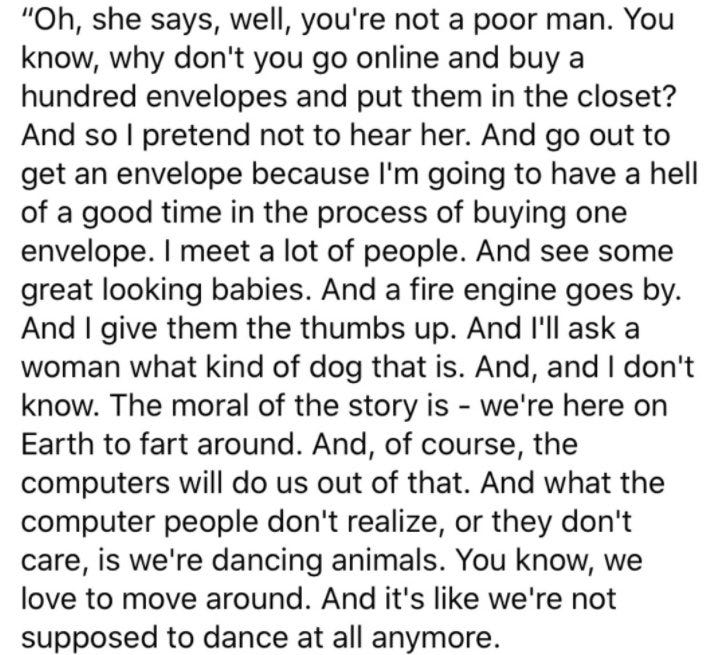
I find that Vonnegut story a nice companion to this tweet I’ve seen floating around lately:

I like this idea: that buying an envelope can be a dance, that going to the grocery store (a task that, when done at the wrong time, or at the Wegman’s in Dewitt, NY, or at the Whole Foods on Mack Avenue in Detroit, makes me feel the way I imagine it would feel to be hunted for sport) can be a dance. That these activities, too, are an opportunity to be embraced. That it is only the baseline of routine that keeps us inhibited from the wonder of day-to-day life.
Something I don’t have to practice feeling this way about is driving my car, and I think the roads would be safer if everyone else did, too. I have been bored on plenty of car trips, but being behind the wheel? Hoo boy. I can’t imagine anything more stimulating, which means I truly can’t understand the people who, even with years of addictive conditioning, manage to reach for their phone to do other stuff while they’re at it. I mean, it’s a staggering thing, being out there. Every day I hit the road and I travel at speeds inaccessible for 99.99% of human history to anyone who wasn’t actively falling off a cliff. I see more square miles of the country in a month than my ancestors did in a lifetime. I may hate what it’s doing to the planet, I may hate the behaviors of other drivers, but I do love driving.
In that same vein I’ve started monitoring trail cams on social media to get a sense, from the animals, of what it’s like to be delighted by, or at least attentive to, the seemingly mundane.

Maybe this is the way out of shirking the labor of being alive, of having needs and desires. Maybe it’s not a trick to learn that there’s real joy in getting to choose how you live every day, even when it’s easier to give in to the slop.
Thanks, as always, for reading. I’ll talk to you next time.
-Chuck
PS - If you liked what you read here, why not subscribe and get this newsletter delivered to your inbox each week? It’s free and always will be, although there is a voluntary paid subscription option if you’d like to support Tabs Open that way.
The fact that I’ve seen a number of variations on this story made me worry that it was a bit of apocrypha, but it turns out that Vonnegut just really liked telling it. Different versions of it appear in at least one interview, one speech to college students, and in his book A Man Without a Country.
This made me think of this quote from Samuel Johnson's 1759 work, "Rasselas," (yes, the inspiration for our first dog's name). ... “The Europeans,” answered Imlac, “are less unhappy than we, but they are not happy. Human life is everywhere a state in which much is to be endured and little to be enjoyed.”
Not a very optimistic take. I'd love to read it again, but I'm not fond of e-books (which are to be endured, not necessarily enjoyed.:) You can find it on gutenberg-dot-org.