
Bubble-Eyed
I know now that to love the living is to love the dead

Note: This piece was originally accepted for publication in a Midwestern literary magazine back in the fall, and then they pulled the rug on me in December after I made some updates they’d asked for. So instead of waiting for another round of reading periods and submission windows to open elsewhere, I’ll share it with you here. Since it doesn’t meet their needs, I hope it meets yours.
The fish had come home some months before. Probably not a year. Then, it had seemed like a long time they were with us, but that was likely a matter of proportion: I myself had only been around a little while.
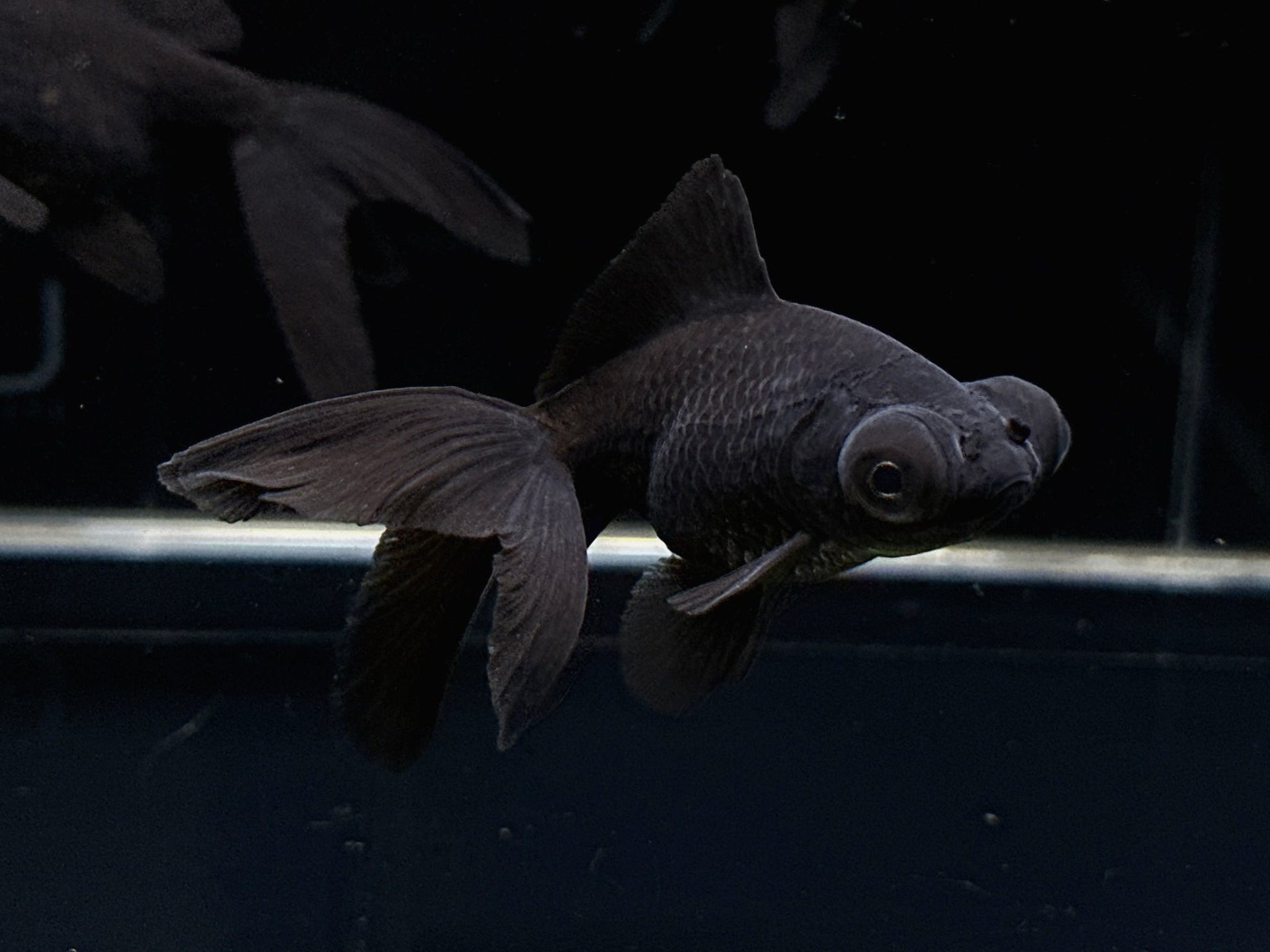
Whether we had asked for the fish or if our mom had bought them of her own volition I can’t remember. I remember their names: Mo, a redcap, for my older brother; Swimmy and Panther, two black bubble-eyed telescope goldfish, for me. My younger brother was too young then to have a fish even nominally attached to him.
I knew, I think, as a child, that the world of adults was an inscrutable one; that they functioned according to different rules, different priorities. I did not presume to become one; we were simply different types of people. It was only when we got the fish that it occurred to me that the lives of other things might also function according to laws beyond what I knew, and so might be worth pondering.
Over the span of a few weeks Panther began to turn from black to orange before my eyes. What kind of panther was he? Better I had waited and called him Tiger, or something, but I had not, and so I was left to lament that my fish and his name were no longer a match, that either Panther or I had chosen our course poorly. (Swimmy, when she turned, was consequently less of a blow.)
I came home with my dad one evening, probably from soccer practice, to find my mom sitting on the side of the bathtub holding Mo in a plastic measuring cup. He was upside down. She was stirring the water back and forth with her finger and speaking words of encouragement, and after each stroke he would move for a while under his own power before drifting to a halt again.
Right around the time my mom was holding Mo in that plastic measuring cup, my elementary school curriculum was covering some of American history’s heavy hitters with units on Abraham Lincoln and Dr. Martin Luther King, Jr. We learned not only about their struggles for freedom but about the grisly, possibly inevitable ends they each met. The stories of their lives could not be told to us without the stories of their deaths. What better way to illustrate the significance of all they had said and done?
There was nothing for me, then, that separated the murders of Lincoln and King, the illustrations from books showing processions of mourners and railcars draped in black bunting, from the image of my mom’s face when she emerged from her bathroom vigil to tell us that Mo had stopped swimming for good. All of it, those balcony gunshots a century apart, the round body wrapped neatly in toilet paper in her outstretched palm, belonged to the same dark side of existence, to a set of facts that, once learned, became for me as toothpaste squeezed from the tube: no going back. I knew, suddenly and clearly, that death was true, and that I did not want it to be. And if it were true, it certainly wasn’t fair, for neither Mo nor King nor Lincoln deserved it.
I learned the lesson again as each of the other fish of our household succumbed to the same fate. And then again with the series of fish we got to replace them, and with a hardy crayfish brought home from a class project, and with a pair of mice that kept escaping their plastic home into our human one, and with a succession of finches my mom adopted when the school where she taught no longer wanted them, and with a pair of tree frogs I inherited from my older brother’s ex-girlfriend, and with a family dog who hung around us for twelve decent years.
Ours was always a household of creatures, and I wanted, then, each time, to put death back beyond my reach. To send death elsewhere, to live a life entirely without the pain of mortality—for myself and for all the people and animals I loved.
But of course the pain came. Of course there is always pain coming. Why should we be exempt? The deer runs through the deep meadow and emerges quivering, paralyzed by ticks. The wolf breaks one leg and runs on three for two agonizing months. The bird and the window, the bird and the windshield. The jaws of the trap are set with every birth and sprung again and again with neither malice nor morality anywhere in the reckoning.
I claim to understand this even as I shy from the implications. It’s easy enough to pluck examples from the animal world like I’m scripting a nature documentary. It’s harder to look honestly upon the time to come when I’ll own a suit I wear to funerals, when its black elbows will turn soapworn with use. It’s hard for me to sit with notions of any end, be it sudden or dwindling: a first drive to the hospital, a final drive to the vet. Most of my life is constructed around the basic truth that the pain is coming, and that I would rather it didn’t. In fact I would rather not think about it at all.
Every morning—too early—I beam the news of the world straight into my face upon waking. The pain is everywhere, it turns out, and at a scope that makes that first lesson feel so distant that it might belong to another life entirely. Death as a single stilled body of scales is one thing, but the words themselves have to get bigger along with the size of the catastrophe. Catastrophe, there’s one. Annihilation, that’s another. In childhood, at that first moment, I was called to reckon with an upside down fish as the end of an entire universe. The distance between that single apocalypse of fish and the wanton suffering I am expected to simply observe and countenance now is staggering. Numbing, mind-boggling, stupefying. More big words. So many universes collapse at once all over the world each day that I find myself wondering how every bit of matter hasn’t disappeared down some black hole by now. Most of the time this feels like the only result that would be commensurate with the breadth of the horrors.
But recently a dog I cared about deeply—not mine—died at a ripe old age. And while his loss hit me hard, what perhaps shocked me most was that for the first time in recent memory, my grief felt the right size. It was recognizable, understandable. Able to be named and reckoned with inside a single human heart. In the absence of that wizened little body, I found not the same old longing for death to disappear, but a gratitude to have found an instance of it that was comprehensible at all. The smallest of mercies; one last gift from a little guy who gave me plenty. For I know now that to love the living is to love the dead. Friends, family, dogs, fish, houseplants. Uncountable masses will pass me by on earth each day before my turn.
Well, but that’s the deal, isn’t it? And there’s no backing out of it. You take the deal because you have no choice. But you can still choose.
Some choices:
Last week I ushered a big spider out of the house and into the yard. Spiders always fight me on this, though they never say whether it’s because they don’t understand what I’m doing or because they understand all too well. It’s warm in the house, and there are plenty of opportune corners, and it’s getting cold outside in our thorny garden.
This week I set two mousetraps. They both went off. My wife gathered the little bundles of mouse from where they lay in the pantry. We took them to the woodpile, said a few words that were prayer and apology all in one. Buried them. Went back inside and held our own dog and cried.
Some days it’s clear that I am still that child waiting outside the bathroom, head full of black bunting, with no idea what to do about the end.
Thanks, as always, for reading. I’ll talk to you next time.
-Chuck
PS - If you liked what you read here, why not subscribe and get this newsletter delivered to your inbox each week? It’s free and always will be, although there is a voluntary paid subscription option if you’d like to support Tabs Open that way.
Aww... this one made me cry!! SO beautifully written!
F*** that literary magazine! Their loss was OUR gain!
(Pardon my potty mouth...) Thanks, Chuck!!
You’ve always been the next great American writer to me. More evidence for the list.